AEM 6850

Empirical Methods for Applied Economists

Prof. Ariel Ortiz-Bobea

17 · Text II: LLMs

Tuesday, October 27, 2026

Cornell University

Plan for today

  1. When to use an LLM
    What a language model does · three things it can do with text · a regular expression, a model or a person · one task both ways · caveats · Exercise 1
  2. The use of labels
    What a label is · checking a model’s error rate · hand labels to train a model or to check it · how two people make them · agreement
  3. Using a closed LLM
    2,480 Fed sentences labelled by hand · the codebook as the model’s instructions · the call from R · one saved reply · five sentences: you, then the model live · why every reply is saved · the score on all 2,480 · where the errors are · Exercise 2 · the cost
  4. Using an open-weight LLM
    What an open-weight model is · downloading one · the same call from R · open against closed on 2,480 sentences · what hardware buys you · a coding agent runs it · the stance of every Fed statement, 2006–2026

LLM: a large language model, a program that writes a reply to written instructions. Running example: the policy statements of the Fed (the US central bank) and sentences from its meetings. All model answers were saved before class, so no account or password is needed. In the R Console, now: install.packages("jsonlite") to read them. Then download and unzip 17-text-llms.zip from this session’s page on the course website and open 17-text-llms.Rproj. That page also holds the full code and eleven practice exercises, with solutions.

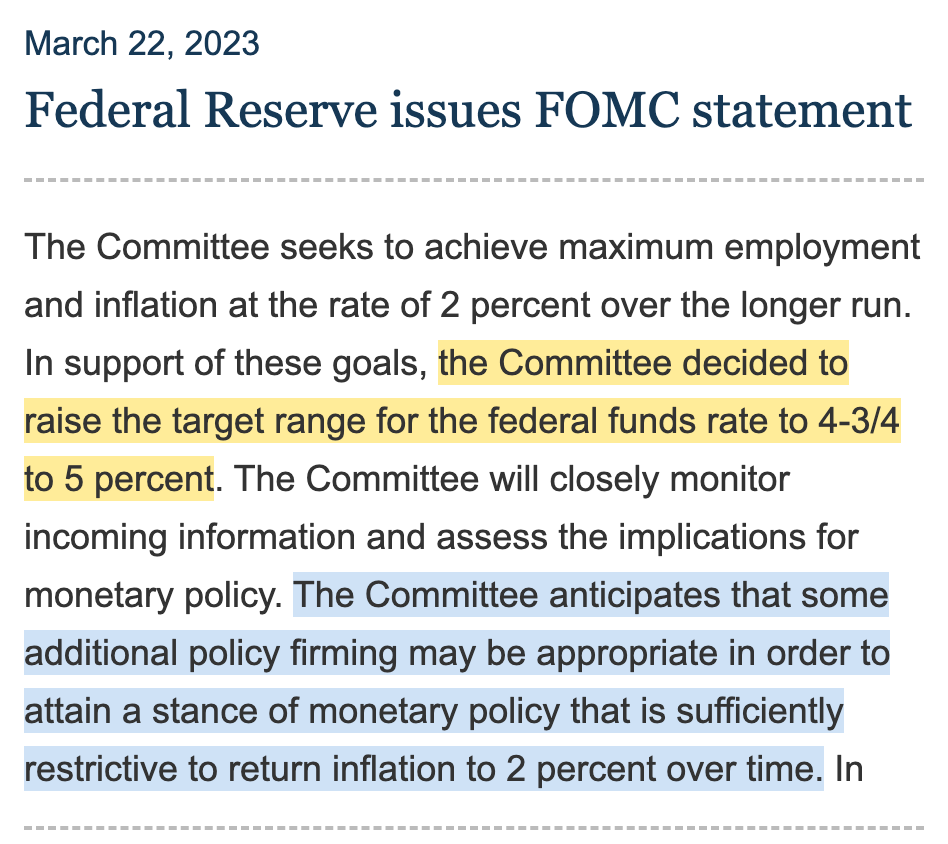
The Fed’s statement of 22 March 2023

Today’s running example is the text the Fed publishes. The FOMC, the rate committee of the US central bank (the Fed), publishes a statement after each meeting. A statement sets a target range for the main interest rate and hints which way rates go next.

  • target range: the band for the federal funds rate, the rate on overnight loans between banks.
  • hawkish: pointing to higher rates, to slow inflation.
  • dovish: pointing to lower rates, to support jobs and growth.

Yellow: the target range the statement sets. Blue: a hint about future rates (“firming”: raising them). Board of Governors of the Federal Reserve System; public domain.

Two variables from the same statement

A language model reads the Fed’s statement of 22 March 2023 and returns a number and a judgement.

The target range The stance of a sentence
The model reads one whole statement one sentence at a time
Example “…the Committee decided to raise the target range for the federal funds rate to 4-3/4 to 5 percent” “The Committee anticipates that some additional policy firming may be appropriate…”
The model returns lower = 4.75, upper = 5 one label (here hawkish)
Checked against FRED, the Fed’s own daily record of the range labels two people made by hand (stance has no official record)

FRED: the free data service of the Federal Reserve Bank of St. Louis. stance: which way a sentence leans, toward higher rates (hawkish), lower rates (dovish), or neither (neutral).

1 · When to use an LLM

  • What a language model does
  • Three things it can do with text: classify, extract, match
  • Choosing the tool for the task
  • Testing a pattern and a model on one task
  • Three caveats before using a model
  • Exercise 1

What can a language model do with text, and when is it the right tool? Economists turn text into variables; a model is one of three ways to do it.

What a language model does

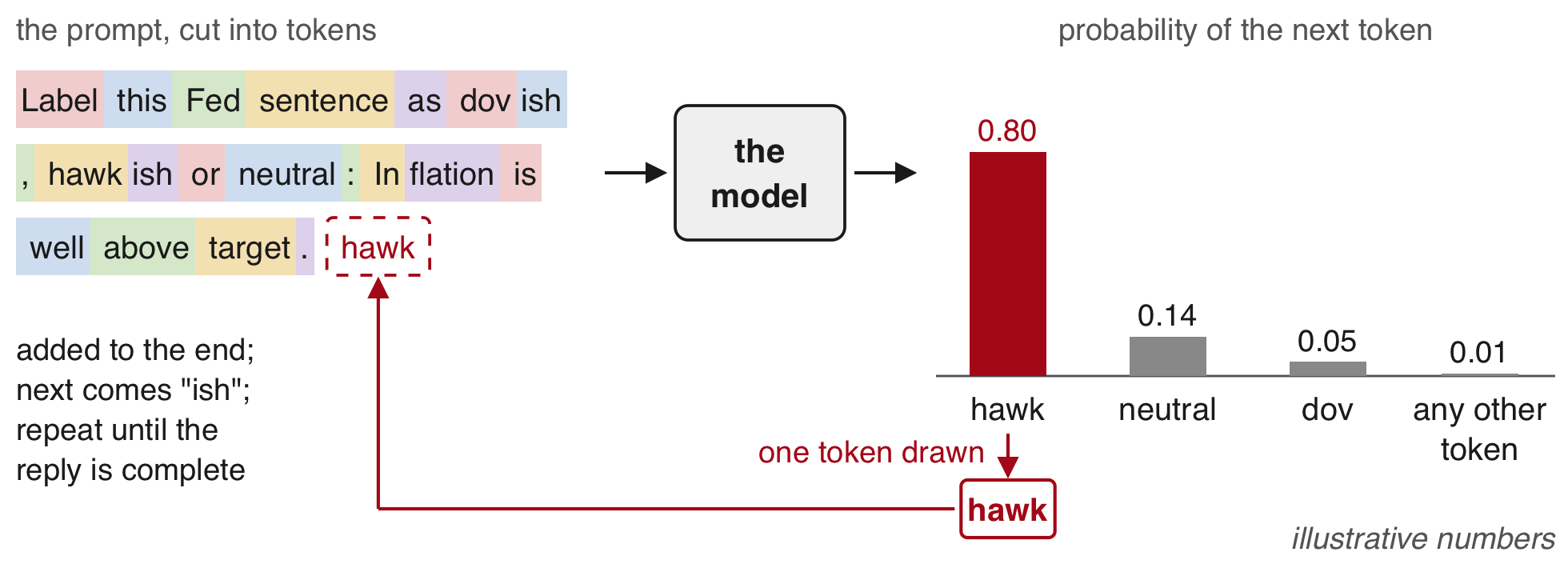
  • LLM (large language model): a model trained on a vast amount of text to predict the next token; “model” on these slides means one. token: a word or a piece of a word. prompt: the instructions plus the item you send. reply: the text the model writes back, one token at a time.
  • A word count, the older tool, scores each word on its own from fixed lists of good and bad words: confident counts as good even after “not”, and “not” and “despite” count for nothing.
  • The model reads every token with the tokens around it before it writes, so “not yet confident” reads as doubt.

Three things a language model can do with text

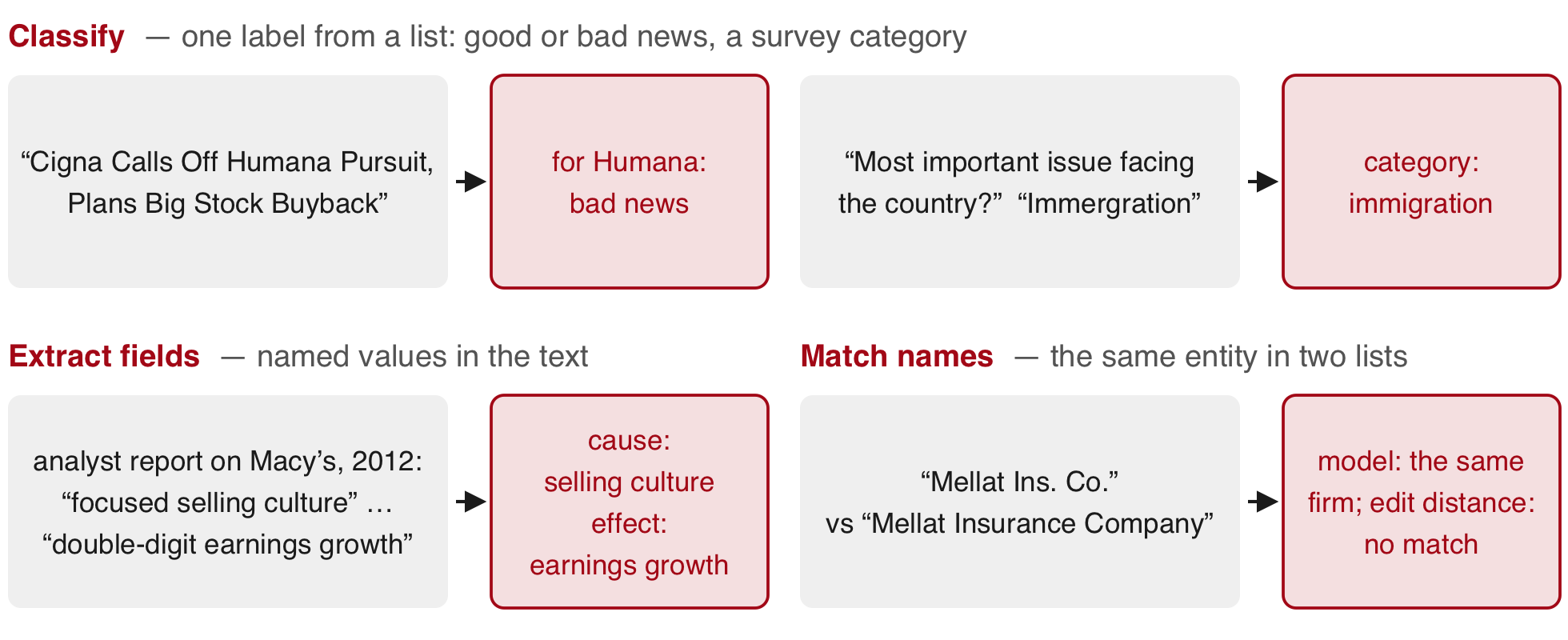
Each use turns text into a variable. Classifying picks a label from a list; extracting copies pieces out of the text; matching decides whether two names mean the same firm. edit distance: the number of characters to change to turn one name into the other. The examples, each explained on the next slides: a takeover headline, a misspelled survey answer, a stock analyst’s report, a firm name written two ways.

Classify: Lopez-Lira & Tang (JFE, 2026); Bursztyn et al. (AER, 2025), example from Mellon et al. (2024). Extract: Li et al. (RFS, 2026). Match: Dell (JEL, 2025); Allen & Hatfield (2025).

Classifying text: sentiment and stance

  • Sentiment: whether a text is good or bad news for someone.
  • Stance: which way a text leans, such as toward higher or lower interest rates.
“Cigna Calls Off Humana Pursuit, Plans Big Stock Buyback” For Humana’s stock
A language model bad news: a buyer willing to pay above market price walked away
A data vendor’s sentiment score, −1 to +1 +0.65, good news

Cigna, a US health insurer, had been trying to buy Humana. Headline from December 2023; example from Lopez-Lira & Tang, working-paper version, pp. 15–16. JFE: Journal of Financial Economics.

Extracting fields from documents

Extracting copies named pieces out of a document into columns, one field per column. A label picked from a list is classification.

Field Copied from an analyst report on Macy’s, March 2012
cause “focused selling culture”
effect “double-digit earnings growth through 2015”
  • Li, Mai, Shen, Yang & Zhang (RFS, 2026): a model read the culture passages of about 2.4 million analyst reports. It extracted cause and effect, and classified each passage’s culture type and tone.
  • On 200 passages labelled by hand, the culture type was right 98.5% of the time.

Analyst report: a stock analyst’s report on a company, here by JP Morgan. Review of Financial Studies; example from the authors’ working-paper version.

Matching names across datasets

  • The same firm is written differently in different files, so linking two datasets means matching names.
  • Dell (JEL, 2025): matching 1950s Japanese firm records with a language model’s embeddings (numbers a model assigns to a text, close for texts that mean the same), trained further on hand-linked examples, found the right firm 91% of the time, against 27% for edit distance (the number of characters you must change to turn one name into the other).
Name in the second list The same firm as “Mellat Insurance Company”? Edit distance
“Mellat Ins. Co.” yes 11
“Mellot Insurance Corp.” no, a different firm 5

Edit distance calls the different firm the closer match. A model reads “Ins.” as “Insurance” and “Co.” as “Company”.

Name pair from Allen & Hatfield (Federal Reserve working paper, 2025), on firms in the US sanctions list. Edit distances from R’s adist().

Choosing the tool for the task

Three tools turn text into a variable. The task decides which one:

A pattern (regular expression) A language model A person
Suits a fixed format: dates, codes meaning that changes with the wording few items, or the reference labels
Cost free per token, or free on your own computer about 15 seconds a sentence
Speed on today’s data 171 Fed statements in under a second the same 171 in 18 seconds 2,480 Fed sentences in about 10 hours
Same answer every run yes not guaranteed not guaranteed either
Checked against example strings, or an outside record an outside record, or a hand-labelled sample a second person

Start from the task: if the wording never changes, write a pattern; if meaning matters, use a model and check it; if the items are few or the labels are the reference, read them yourself. regular expression: a written search pattern that matches text by its form.

Testing a pattern and a model on one task

The choice, tested on one task. From each of the Fed’s 171 policy statements (2006–2026), read the target range for the federal funds rate, the Fed’s main interest rate, once with a pattern and once with a model, and compare each with FRED, the Fed’s own daily record of the range (from the Federal Reserve Bank of St. Louis).

A regular expression A language model
Right, against FRED 145 of the 145 it read 170 of 171
No answer 26: the 25 statements of 2006–2008 that set one number (“at 5-1/4 percent”), and 17 Aug 2007, which states no target 1: 17 Aug 2007, left empty as its instructions said
Time and cost under a second, free 18 seconds, about 47 cents

The pattern would need a second pattern for the single-number years; the model read both wordings. When the wording is fixed, the free pattern does the job. The code for both, step by step, is on the session page.

Three caveats before using a model

A language model reads text you supply. Before you rely on its labels:

  • Results move with the model and the prompt (the instructions sent). Across models and prompts, the estimated effect of a “good news” label on the next day’s stock return ran from −2.48 to 0.08: even the sign changed. Labelling a random 5% by hand measures the model’s errors, so you can report them and correct the estimate for them.
  • It costs money, charged per token (a piece of text).
  • It remembers text from its training, so it may have seen the outcome you want to predict: it completed 344 descriptions of bills before the US Congress (proposed laws) word for word. What it knows about a firm can change its answer:
Headline (only the firm’s name differs) Model’s answer
“Facebook not planning to extend European privacy law globally” good for the stock
“Blahblahblah not planning to extend European privacy law globally” bad for the stock

Bills, stock returns and the 5% fix: Ludwig, Mullainathan & Rambachan (Annual Review of Economics, 2026). Headline pair: Glasserman & Lin (Journal of Financial Data Science, 2024).

Exercise 1

With your neighbour, no computer (4 minutes). For each task: a regular expression (a written search pattern), a language model or a person? For each model answer, what would you check it against?

  1. The date of each FOMC (Fed rate-setting committee) meeting, from the statement’s first line
  2. Every five-digit US ZIP code in 100,000 addresses
  3. How often “inflation” appears in each statement
  4. 50,000 product reviews: positive or negative
  5. 3,000 answers to “Why did you move?”, sorted into reasons
  6. 20,000 firm names in loan records, matched to a list of listed firms
  7. The amount in 10,000 contracts: “USD 1.2 million”, “$1,200,000” or in words
  8. 2 million job ads, coded into occupations
  9. Whether one 40-page court ruling supports a claim in your paper
  10. 200 Fed (US central bank) sentences, labelled to judge a model’s labels

1–3 a regular expression · 4–8 a language model · 9–10 a person

Patterns for fixed formats (1–3). A model where meaning matters, checked on a hand-labelled sample (4–8; task 7 can mix a pattern for the fixed formats with a model for the rest). A person for one high-stakes item (9) and for the reference labels (10). Task 6 is checked against a few hundred pairs matched by hand.

2 · The use of labels

  • What a label is
  • Checking a model’s error rate
  • Hand labels to train a model or to check it
  • How two people make hand labels
  • Agreement between two people

What is a label, and when do you make labels by hand: to train a model, or to check how often it is wrong? A model’s answers are a measurement, and you need something to compare them with.

What a label is

A label is the category assigned to one item. Data in which every item carries one are labelled data. (The Fed: the US central bank.)

Item Label Assigned by
Fed sentence: “And inflation is well above target.” hawkish (higher interest rates ahead; the other labels: dovish, neutral) two researchers (a hand label)
the same sentence hawkish a language model
Survey answer, misspelled: “Immergration” immigration a survey coder
  • A label is not a feature. Features describe the item (its words, its date).
  • A label is not the codebook. The codebook is the written guide for choosing labels, such as “inflation rising: hawkish”; a label is what one item gets.
  • A label is not the truth. It measures the true category with error (misclassification); the two researchers agreed on 9 in 10 Fed sentences.

Checking a model’s error rate

A model’s labels have an unknown error rate. Compare them with a reference:

  • An outside record, when one exists: the Fed’s target range (its main interest rate), read by a model from 171 policy statements and checked against FRED, the Fed’s daily record: 170 of 171 matched.
  • Hand labels on a random sample, when none exists: nobody records whether a Fed sentence is hawkish (pointing to higher rates), so two people label a sample; the model’s agreement with them is its score.

About 200 random items pin the error rate within about ±7 percentage points (two standard errors of a share near one half); all 2,480 Fed sentences within ±2. Once checked, the model labels other text, which nobody labels by hand.

What hand labels are for

Hand labels have two jobs. Thousands train (fine-tune) a model for your own categories; a few hundred random ones check a model’s output. A large model used as it is needs only the check, and an outside record can replace even that.

Text Audio Images
Train Moreno-Medina et al. (QJE, 2025) trained a model on about 200,000 news stories labelled by topic, to sort TV news into topics clips transcribed by hand train a speech-to-text model for one accent or subject photos labelled by workers paid per photo on online platforms
Check two people label Fed sentences hawkish (higher rates), dovish (lower) or neutral: how often the model agrees a hand transcript of a short clip: the share of words the model gets wrong random photos labelled by hand: how often the model agrees
No hand labels the Fed’s interest-rate target range read by the model, compared with FRED, the Fed’s own daily record the model’s list of who spoke when, compared with the official transcript fire damage read from photos of homes, compared with inspection records

The Fed: the US central bank. QJE: Quarterly Journal of Economics.

How two people make hand labels

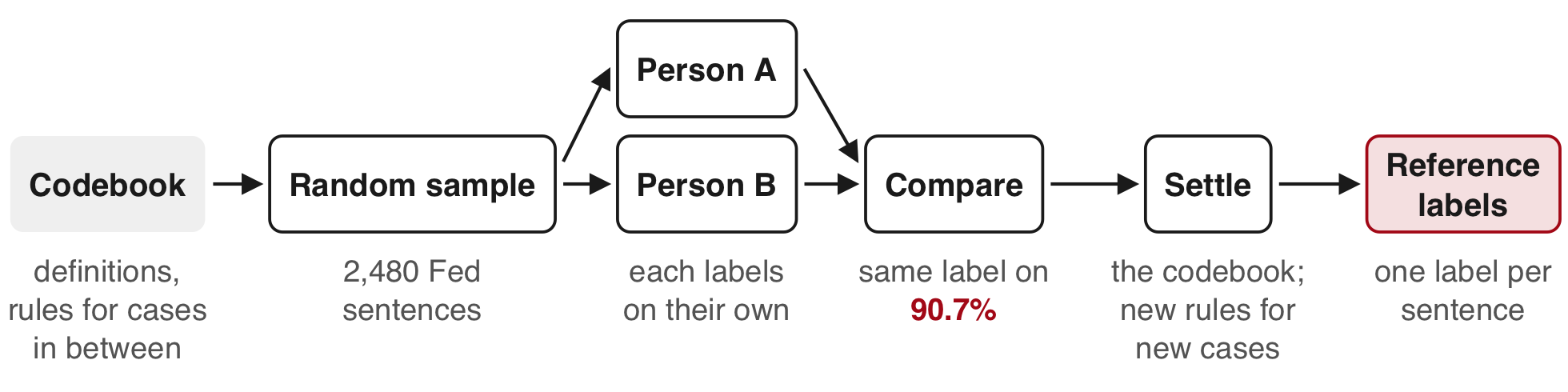
How the 2,480 sentences from documents of the Fed (the US central bank) in the Trillion Dollar Words dataset of Shah, Paturi & Chava (ACL, 2023) got their labels: hawkish (pointing to higher interest rates), dovish (lower) or neutral. Two of the dataset’s authors each labelled the sentences on their own with the codebook, the written rules. They agreed on 90.7% and settled the rest with the codebook, adding a rule for each new kind of case. The published dataset holds only the settled labels: the reference labels, which a model is judged against.

Agreement between two people

R Console
a <- c("dovish", "neutral", "neutral")    # person A's labels for three sentences
b <- c("dovish", "hawkish", "neutral")    # person B, the same three
a == b
#> [1]  TRUE FALSE  TRUE
mean(a == b)                              # mean() of TRUE and FALSE is the share TRUE
#> [1] 0.6666667
  • agreement rate: the share of items given the same label.
  • inter-rater agreement: the agreement rate between two people who labelled the same items on their own. The two who labelled the 2,480 Fed sentences with the codebook agreed on 90.7% before settling the rest.
  • A model that reaches about 90% does as well as careful people.

Agreement before resolving disagreements: 89.0% for sentences from meeting minutes, 95.0% for press conferences, 91.1% for speeches, 90.7% in all (Shah, Paturi & Chava, ACL, 2023, Table 9).

3 · Using a closed LLM

Can a closed model, one that runs on the provider’s computers and bills each call, label the 2,480 Fed sentences, and how would we know?

  1. The data: 2,480 sentences, each labelled by two people
  2. The call from R, one reply, and why every reply is kept
  3. Live: you label five sentences, then the model does, twice
  4. The score on all 2,480, and a cheaper rule (Exercise 2)
  5. The bill

No account with the provider is needed: the saved replies and the data are in the session’s zip file.

2,480 Fed sentences labelled by hand

R Console, in the 17-text-llms folder (unzipped from 17-text-llms.zip); reads tdw_sentences.csv
tdw <- read.csv("tdw_sentences.csv")   # tdw: Trillion Dollar Words, the dataset's name
dim(tdw)
#> [1] 2480    6
tdw$annotators <- c("dovish", "hawkish", "neutral")[tdw$label + 1]   # the release codes 0, 1, 2
table(tdw$annotators)
#> 
#>  dovish hawkish neutral 
#>     650     606    1224

The reference for checking the model: a published dataset, Trillion Dollar Words, with sentences from the minutes (meeting records), press conferences and speeches of the Fed (the US central bank). Two researchers (annotators) labelled each one on their own and settled the rest together; the file holds the settled label as 0, 1, 2, turned into words above:

  • “In addition, U.S. inflation remains muted.” dovish (pointing to lower rates)
  • “And inflation is well above target.” hawkish (pointing to higher rates)
  • “Most other interest rates in short-term markets were little changed over the period.” neutral

Trillion Dollar Words: Shah, Paturi & Chava (ACL, 2023); ACL: the main conference in computational linguistics.

The codebook as the model’s instructions

The two people labelled each sentence by a codebook: the written definition of each label, with rules for the cases in between. Condensed to the box below, it is also what the model is told, so the model and the people follow the same rules:

codebook.txt, in the project folder; sent to the model with every sentence
You label one sentence from a document of the US Federal Reserve: FOMC
meeting minutes, the chair's press conferences, or speeches by Fed officials.
dovish: the sentence points to future easing of monetary policy (lower rates).
hawkish: the sentence points to future tightening of monetary policy (higher rates).
neutral: mixed signals, no change in policy, or not about the policy stance.
Rules for the cases in between:
- Inflation falling, unemployment rising, or growth projected low: dovish.
- Inflation rising, unemployment falling, growth projected high, or output above potential: hawkish.
- Unemployment or growth unchanged, maintained or sustained: neutral.
- The dollar rising in value: dovish. The dollar falling in value: hawkish.
- Oil, energy or house prices falling: dovish. Rising: hawkish.
- The Fed expecting low inflation: dovish. High inflation: hawkish.
- A foreign country's own economy or trade policy: neutral.
- "Accommodative", or a focus on "maximum employment": dovish.
- "Mixed", "moderate" or "reaffirmed": neutral.
Give exactly one label.

FOMC: the Fed’s rate-setting committee. potential output: what the economy can produce with full use of its workers and machines. accommodative: keeping rates low. A stronger dollar makes imports cheaper and lowers inflation, so it is dovish. Condensed once from the annotators’ guide (Shah, Paturi & Chava, ACL, 2023), before any reply, and never edited after.

Calling the closed model from R

Run by the instructor before class: model_setup.R (part); needs ellmer and an API key in ~/.Renviron
library(ellmer)            # install.packages("ellmer") once; calls language models from R
MODEL <- "<model id>"      # the full model id from the provider's list, written once
CODEBOOK <- paste(readLines("codebook.txt"), collapse = "\n")       # the box on the previous slide
stance_type <- type_object(stance = type_enum(c("dovish", "hawkish", "neutral")))   # the only answers allowed
chat <- chat_anthropic(system_prompt = CODEBOOK, model = MODEL, cache = "none")
chat$chat_structured("And inflation is well above target.", type = stance_type)    # one sentence in, one label out
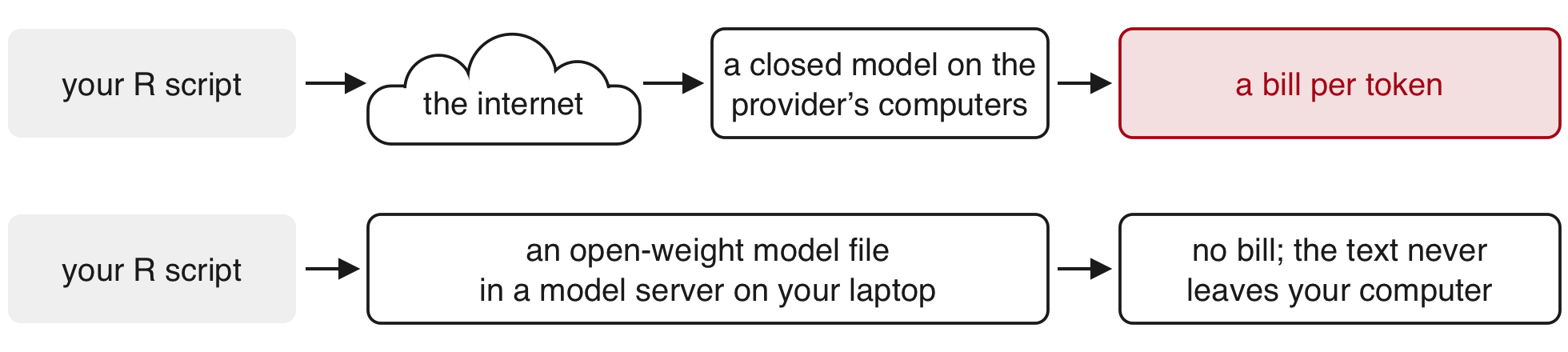
  • closed model: runs on the provider’s computers (Anthropic for chat_anthropic()), weights unpublished, each call billed through the API, the web address R sends requests to. The API key is a password that bills your account, kept in ~/.Renviron, never in a script.
  • system prompt: instructions sent with every item, here the codebook with each sentence. type_enum() limits the reply to the three labels (enum: a fixed list of allowed answers); cache = "none": no discount on the resent instructions, so the bill later is the full price. The run before class: this call once per sentence, 2,480 times.

One saved reply, as the provider sent it

Each call’s reply was saved as one file before anything was done with it. The file for “And inflation is well above target.” (sentence 904, hawkish by hand):

R Console, in the 17-text-llms folder; needs jsonlite; reads one saved file; no API key
library(jsonlite)                        # reads JSON, the text format replies arrive in
r <- fromJSON("replies/run1/904.json")   # one of the 2,480 saved files
r$answer$stance                          # the label the model gave
#> [1] "hawkish"
r$reply$model                            # the model id the provider reports
#> [1] "claude-sonnet-5-5"
r$reply$content$text                     # the reply's text, as the model wrote it
#> [1] "{\"stance\":\"hawkish\"}"
r$reply$stop_reason                      # why the model stopped writing
#> [1] "end_turn"
unlist(r$reply$usage[c("input_tokens", "output_tokens")])   # tokens billed: sent, written back
#>  input_tokens output_tokens 
#>           647            14

raw reply: the reply exactly as the provider sent it. token: a word or a piece of a word, the unit providers bill by. stop reason: end_turn means the model finished its answer. The session’s results are read from these 2,480 files.

Why every reply is saved to disk

  • A reply can change. The model draws each token of its reply from probabilities, so close calls can flip: two full runs over the 2,480 sentences, same codebook and model id, changed 51 labels. temperature, the setting for how much the draws vary, cannot be set on the newest closed models (the call returns an error).
  • Providers also retire models. A saved raw reply, like the file for sentence 904 on the previous slide, keeps the label, the exact model id, the text and the tokens billed, with no call needed again.
save_replies.R (part), inside the loop over items j; the whole function is in the project and on the session page
if (file.exists(f)) next                                       # f: this item's file; saved already: skip
chat <- chat_anthropic(system_prompt = prompt, model = MODEL, cache = "none")   # a fresh conversation per item
ans <- chat$chat_structured(texts[j], type = type)              # the call: one label back
rec <- list(id = ids[j], answer = ans, model = MODEL,
            reply = chat$last_turn()@json)                     # the reply as the provider sent it (JSON)

A fresh chat for each item, because a chat resends its whole conversation and earlier sentences would sway later ones. An interrupted run resumes where it stopped, and a rerun makes no call.

Five Fed sentences to label yourself

Now the live part: five sentences drawn at random with a seed (set.seed(6850), the same five for everyone). Label each hawkish (higher interest rates ahead), dovish (lower) or neutral before the model does, because a label you have seen pulls yours towards it.

  1. Mortgage rates, corporate bond rates, and other yields and asset prices moved in sympathy, with important effects on the cost of borrowing and hence, presumably, on aggregate demand.
  2. Several mentioned that the revisions to the NIPA pointed to a modest downward adjustment in projected growth of actual and potential GDP,
  3. We expect the economy will continue to perform well, with the job market strengthening further and inflation rising to 2 percent over the next couple of years.
  4. However, it was noted that the Committee had in place tools that would enable it to remove policy accommodation quickly if necessary to avoid an undesirable increase in inflation.
  5. On the upside, bottlenecks, supply disruptions, and historically high rates of resource utilization were seen as potential sources of greater-than-expected inflationary pressures, particularly if there were a significant rise in inflation expectations that altered inflation dynamics.

moved in sympathy: moved together. NIPA: the US national accounts. several: several Committee members. the Committee: the group in the Fed that sets interest rates. policy accommodation: keeping rates low. resource utilization: how fully workers and factories are in use.

The closed model labels your five live

Run by the instructor, live: demo.R, part 1; needs ellmer (calls models from R), the API key and model_setup.R
source("model_setup.R")                    # loads ellmer; MODEL, CODEBOOK, stance_type
tdw <- read.csv("tdw_sentences.csv")
set.seed(6850)
pick <- sample(nrow(tdw), 5)               # the five sentences you labelled
chat <- chat_anthropic(system_prompt = CODEBOOK, model = MODEL, cache = "none")
five <- as.list(tdw$sentence[pick])
live1 <- parallel_chat_structured(chat, five, type = stance_type, on_error = "stop")   # stop at the first error
live2 <- parallel_chat_structured(chat, five, type = stance_type, on_error = "stop")
data.frame(annotators = c("dovish", "hawkish", "neutral")[tdw$label[pick] + 1],   # the file codes labels 0, 1, 2
           live1 = live1$stance, live2 = live2$stance)
identical(live1$stance, live2$stance)

The five you just labelled, sent from this laptop to the closed model twice, now, with the codebook as instructions (CODEBOOK) and the three labels as the only answers allowed (stance_type). Watch whether the two runs agree with each other and with your labels; identical() prints TRUE when the runs match. parallel_chat_structured() sends the five at once, each as a fresh conversation; annotators is the two people’s label. If the call fails, the next slide prints the saved run’s labels for the same five.

The closed model scored on all 2,480 sentences

R Console; needs tdw (the 2,480 Fed sentences); reads the closed model's saved labels; no key
labels <- read.csv("replies/labels_run1.csv")         # the 2,480 saved replies, collected: id, stance, tokens
tdw$model <- labels$stance[match(tdw$id, labels$id)]  # the model's label next to the people's
set.seed(6850); pick <- sample(nrow(tdw), 5)          # the five you labelled: a seed fixes a random draw
data.frame(annotators = tdw$annotators[pick], model = tdw$model[pick])
#>   annotators   model
#> 1    hawkish neutral
#> 2     dovish  dovish
#> 3    neutral hawkish
#> 4    hawkish hawkish
#> 5    hawkish hawkish
mean(tdw$model == tdw$annotators)                     # agreement rate on all 2,480
#> [1] 0.6935484

Before class the closed model labelled all 2,480 sentences following the codebook, one call each; labels_run1.csv collects the saved replies (stance: the label), and reading it needs no key. On your five it matches the two people on 3; on all 2,480, on 69.4%, its agreement rate with the hand labels, the same measure as between two people. The two people agreed with each other on 90.7%, so the model falls well short of a careful person. Whether that rate is good enough depends on the use; the measured error is what you report.

Where the model’s labels go wrong

R Console; needs tdw with columns annotators (hand labels) and model (the model's labels)
tab_m <- table(annotators = tdw$annotators, model = tdw$model)   # hand labels in rows, the model's in columns
round(prop.table(tab_m, 1), 2)        # shares within each row
#>           model
#> annotators dovish hawkish neutral
#>    dovish    0.68    0.07    0.25
#>    hawkish   0.10    0.57    0.33
#>    neutral   0.16    0.08    0.76
diag(tab_m)                           # counts where both agree: the diagonal
#>  dovish hawkish neutral 
#>     444     347     929
sum(diag(tab_m)) / sum(tab_m)         # over all 2,480: the agreement rate
#> [1] 0.6935484
  • Confusion table: as row shares, the diagonal is the share of each hand label the model gets right. As counts, the diagonal adds up to 1,720 of 2,480, the 69.4% (the row shares weighted by row size). Largest mix-up: hawkish sentences labelled neutral (33% of that row).
  • Base rate: 1,224 of the 2,480 hand labels are neutral, so always answering “neutral” scores 49.4% with no model at all. The model beats it; check this first for any model.

Exercise 2

A cheaper rule than a model is a word count. The Loughran & McDonald (Journal of Finance, 2011) word lists sort words into positive and negative; they were built to score the tone of company annual reports, not policy stance. The rule borrows them: net tone is positive minus negative words per 100 words, and good news points to higher rates, so positive means hawkish, negative dovish, zero neutral. Score the rule as the model was scored (4 minutes, R Console, in the 17-text-llms folder):

  1. Its agreement rate with the hand labels. Above the 49.4% base rate?
  2. Its confusion table as row shares: which wrong label do the people’s hawkish sentences get most?
R Console; needs tdw (the 2,480 hand-labelled sentences); reads lm_words.csv
dict <- read.csv("lm_words.csv")              # Loughran-McDonald word lists
pos <- dict$word[dict$list == "positive"]
neg <- dict$word[dict$list == "negative"]
w <- strsplit(tolower(tdw$sentence), "[^a-z]+")   # the words of each sentence
tdw$tone <- sapply(w, function(x) 100 * (sum(x %in% pos) - sum(x %in% neg)) / length(x))
tdw$rule <- ifelse(tdw$tone < 0, "dovish", ifelse(tdw$tone > 0, "hawkish", "neutral"))
# 1. agreement rate: mean(tdw$rule == tdw$annotators)
# 2. confusion table: tab_r <- table(annotators = tdw$annotators, word_rule = tdw$rule)
#    then round(prop.table(tab_r, 1), 2)
R Console; after the exercise code
mean(tdw$rule == tdw$annotators)
#> [1] 0.4387097
tab_r <- table(annotators = tdw$annotators, word_rule = tdw$rule)
round(prop.table(tab_r, 1), 2)
#>           word_rule
#> annotators dovish hawkish neutral
#>    dovish    0.49    0.16    0.34
#>    hawkish   0.34    0.25    0.41
#>    neutral   0.30    0.20    0.50

The rule agrees on 43.9%, below the base rate; the model reached 69.4%. It calls 41% of hawkish sentences neutral and 34% dovish, because the lists score good or bad news, not the direction of policy:

  • “…were not yet confident that the recent progress … would be sustained.” Dovish by hand; net tone +3.6, so the rule says hawkish: confident and progress count as positive, “not” counts for nothing.
  • “…the unemployment rate had declined substantially.” Hawkish by hand; net tone −6.7, so the rule says dovish: declined counts as negative, though falling unemployment points to higher rates.

The cost of 2,480 labels

R Console; needs labels (the model's saved labels and tokens); PRICE: the provider's list, dated
PRICE <- c(input = 2, output = 10)   # dollars per million tokens; provider's list, 25 Oct 2026
tok <- colSums(labels[, c("input_tokens", "output_tokens")])
tok                                   # tokens billed for 2,480 labels
#>  input_tokens output_tokens 
#>       1723541         50003
sum(tok * PRICE) / 1e6                # dollars; 1e6 is one million
#> [1] 3.947112
hours <- 2 * 2480 * 15 / 3600         # two people, 15 seconds a sentence (an assumption)
WAGE <- 20; c(hours = hours, dollars = hours * WAGE)   # $20 an hour for a person labelling (an assumption)
#>     hours   dollars 
#>  20.66667 413.33333
  • token: a word or a piece of a word, the unit billed. input tokens: the codebook plus one sentence, resent with every call; output tokens: the reply, at several times the input price.
  • cost = input tokens × input price + output tokens × output price, per million tokens; prices change, so the code keeps them in one dated constant, and every reply reports its own token counts.
  • About $3.95 for 2,480 labels; two people at 15 seconds a sentence, about 21 hours and $413, which is why hand-labelled samples stay small. Cheaper: a batch of requests answered within hours (half price), a smaller model, fewer calls.

4 · Using an open-weight LLM

  • What an open-weight model is, and the main ones
  • Downloading the server and one model file
  • The same call from R, and open against closed on 2,480 sentences
  • What hardware buys you
  • A coding agent runs the open model
  • The stance of every Fed statement, 2006–2026

An open-weight model is a file you download once and run on your own computer, with no bill per call. Can it do the closed model’s job?

What an open-weight model is

  • Weights: the numbers inside a model, set in training (also called parameters). An open-weight model publishes them as a model file, gigabytes in size, that anyone can download; a closed model keeps them on the provider’s computers.
  • A model server, a free program, runs the file on your own computer and answers R the way a provider’s API does. The file must fit in memory: about its size plus a few gigabytes.
  • Each lab publishes a family in several sizes, listed on the next slide; speed depends on your machine.

The main open-weight models and their sizes

Each lab publishes a family in several sizes; Qwen is the one run on this laptop next. Parameters: the numbers inside the model (its weights), in billions. Stored at about 5 bits each (8 to a byte), as today’s files are, they take about 0.6 GB of memory per billion, which decides what can run the model.

Family (maker) Billions of parameters Memory needed, and what has it
Gemma (Google) 2 to 31 1 to 20 GB: a laptop
gpt-oss (OpenAI) 21 and 117 13 GB: a laptop; 65 GB: one data-centre GPU
Qwen (Alibaba) 0.8 to 397 0.5 to 240 GB: a laptop, up to a GPU server
Llama (Meta) 1 to 405 1 to 245 GB: the same
DeepSeek 284 and 1,600 170 GB and 1 TB: a GPU server
Kimi (Moonshot) 1,000 and 2,800 0.6 and 1.7 TB: one or two GPU servers
Claude, GPT, Gemini closed, not published the maker’s data centre, reached through the API

Sizes as the makers publish them, October 2026. GPU server: eight data-centre graphics processors (GPUs) of 80 GB or more, rented by the hour. The largest open models are mixtures of experts: all parameters sit in memory, but each token uses a fraction of them (49 billion of DeepSeek’s 1,600), so they run faster than their size suggests. The makers of the closed models publish no sizes; the one widely cited figure, 1.8 trillion for a 2023 GPT model, came from a chip maker’s 2024 keynote.

Downloading the server and one model file

On this laptop, in the Terminal: install the model server (here Ollama) once, download (pull) one small model file, list what is installed, and send one sentence through it. No account and no key.

Terminal, on the instructor's laptop; captured 26 Oct 2026
$ brew install ollama                 # once; or the installer from the server's website
$ ollama serve                        # starts the server; keep this tab open (the installer app does it for you)
$ ollama pull qwen3.5:4b-q4_K_M       # one model file, downloaded once
pulling manifest
pulling e56a899b1540: 100% ▕██████████████████▏ 675 MB
pulling a9d0a3e1d8c9: 100% ▕██████████████████▏ 2.6 GB
pulling 788a4d94bc3f: 100% ▕██████████████████▏ 177 B
verifying sha256 digest
writing manifest
success
$ ollama list
NAME                  SIZE
qwen3.5:27b-q4_K_M    17 GB
qwen3.5:4b-q4_K_M     3.3 GB
qwen3.5:9b-q4_K_M     6.6 GB
$ ollama run qwen3.5:4b-q4_K_M --think=false "Label this sentence from the US Federal Reserve \
    as hawkish (pointing to higher interest rates), dovish (lower rates) or neutral. \
    Answer with one word. Sentence: And inflation is well above target."
Hawkish

The file’s name says its size in billions of weights and how the weights are compressed to fit in memory. --think=false turns off the reasoning text some models write before answering.

The same call from R, to the open model

Run by the instructor, live: demo.R, part 2; needs ellmer and the model server
LOCAL_MODEL <- "<model file name>"   # the open model's file, set once
chat_local <- chat_ollama(model = LOCAL_MODEL, system_prompt = CODEBOOK,
                          params = params(temperature = 0, seed = 6850,
                                          reasoning_effort = "none"))
sapply(tdw$sentence[pick], USE.NAMES = FALSE,
       function(s) chat_local$clone()$chat_structured(s, type = stance_type)$stance)
R Console; needs tdw (the 2,480 sentences) and pick (your five); reads the open model's saved labels; no key
open4 <- read.csv("replies/local_4b.csv")   # id, stance, seconds; the small open model, before class
data.frame(annotators = tdw$annotators[pick], closed = tdw$model[pick],
           open = open4$stance[match(tdw$id[pick], open4$id)])
#>   annotators  closed    open
#> 1    hawkish neutral neutral
#> 2     dovish  dovish  dovish
#> 3    neutral hawkish hawkish
#> 4    hawkish hawkish neutral
#> 5    hawkish hawkish hawkish

chat_ollama() replaces chat_anthropic(); CODEBOOK, stance_type and the sentences are the same. The open model accepts a temperature of 0 and a seed, so a run repeats exactly; reasoning_effort = "none" turns off thinking (2 seconds a sentence instead of 23 to 126). Live now: your five sentences. In the table, the same run saved before class, annotators is the two people’s hand label, closed the closed model’s, open the open model’s; the closed model matches the people on 3 of 5, the open model on 2.

Open against closed on 2,480 sentences

R Console; needs tdw (the 2,480 sentences), tok and PRICE (the cost slide); reads the open models' saved labels
score <- function(stance, seconds, dollars)
  c(agreement = mean(stance == tdw$annotators, na.rm = TRUE),
    sec_each = median(seconds, na.rm = TRUE),
    hours_all = sum(seconds, na.rm = TRUE) / 3600, dollars = dollars)
open <- sapply(c("4b", "9b", "27b"), function(s) {          # billions of weights
  d <- read.csv(paste0("replies/local_", s, ".csv"))         # id, stance, seconds
  d <- d[match(tdw$id, d$id), ]
  score(d$stance, d$seconds, 0)
})
closed <- c(agreement = mean(tdw$model == tdw$annotators),
            sec_each = 2.0, hours_all = 10.5 / 60,     # 2 s a call, 8 at a time (run log)
            dollars = sum(tok * PRICE) / 1e6)          # tok: the tokens billed, cost slide
round(cbind(open, closed), 3)
#>              4b    9b   27b closed
#> agreement 0.644 0.622 0.696  0.694
#> sec_each  1.680 2.760 7.730  2.000
#> hours_all 1.146 1.876 5.444  0.175
#> dollars   0.000 0.000 0.000  3.947

Three sizes of one open-weight model, run on this laptop (64 GB), and the closed model each labelled all 2,480 hand-labelled Fed sentences (hawkish, dovish or neutral). The 27-billion model agrees with the hand labels as often as the closed model, free per call but over 5 hours to its 10 minutes; the 9-billion does worse than the 4-billion. So yes, an open model can do the closed model’s job here, at the cost of time, once each candidate is scored against the hand labels. Always “neutral” would score 0.494; the two people agreed on 0.907.

What hardware buys you

To run an open-weight model, its whole file must sit in memory (a Mac’s shared memory, or a PC’s graphics-card memory), so memory decides which models fit. Memory bandwidth, in gigabytes a second (GB/s), decides how fast the model writes, because each new token reads the whole file once.

Machine Memory Bandwidth Largest model that fits Speed, this laptop = 1
Typical laptop 16 GB about 100 GB/s about 9 billion weights about ¼
This laptop 64 GB 400 GB/s about 35 billion 1 (measured)
Desktop graphics card 32 GB 1,792 GB/s about 27 billion about 4.5
Rented data-centre GPU 80 GB and up over 3,000 GB/s 70 billion and up about 8

GPU: a graphics card, the processor these models run on; its memory is the model’s alone, while a laptop shares its memory with everything else running. Speed: tokens written per second, estimated from bandwidth except this laptop’s. The machines, their specifications and prices: session page.

A coding agent runs the open model

The last step: a coding agent, an AI tool such as Claude Code, writes and runs code from a request in plain words, this pipeline included. A request of this kind produced this project’s run_local.R:

In R with the ellmer package (it calls language models from R), write
run_local.R: label every sentence in tdw_sentences.csv with the open model
that the model server on this computer runs, with codebook.txt as the
system prompt (the rules sent with every sentence) and the three-label
answer format from model_setup.R. Save id, label and seconds to a CSV,
skipping ids already saved. Before the full run, show me the labels of 20
sentences next to their hand labels.

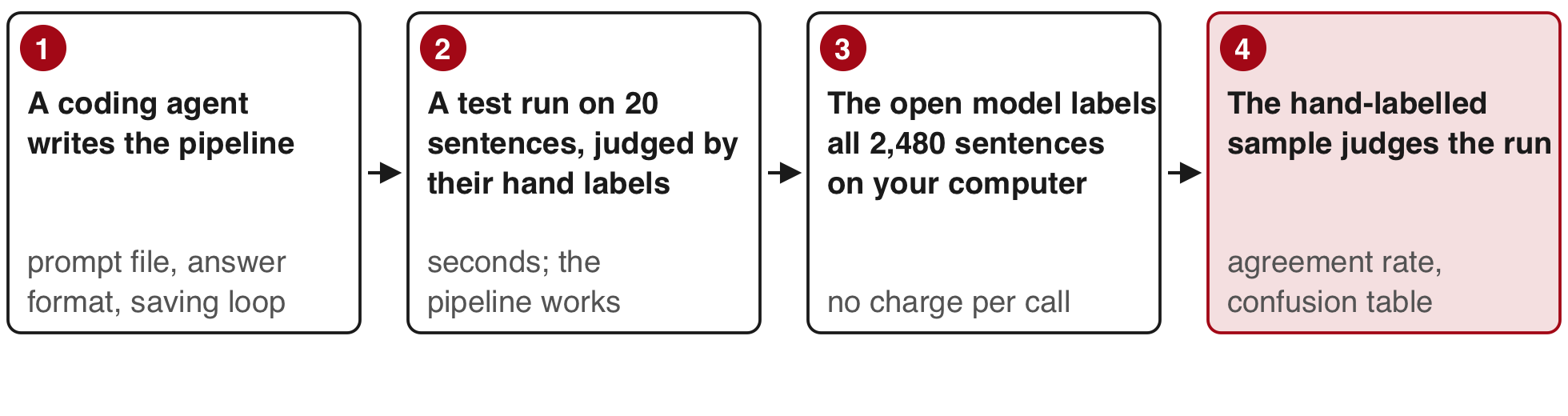
A test on 20 sentences shows that the pipeline works; the open model then labels all 2,480 for nothing; the hand-labelled sample judges the result. run_local.R and its output, replies/local_4b.csv, are in the project folder you unzipped.

Stance and net tone, 2006–2026

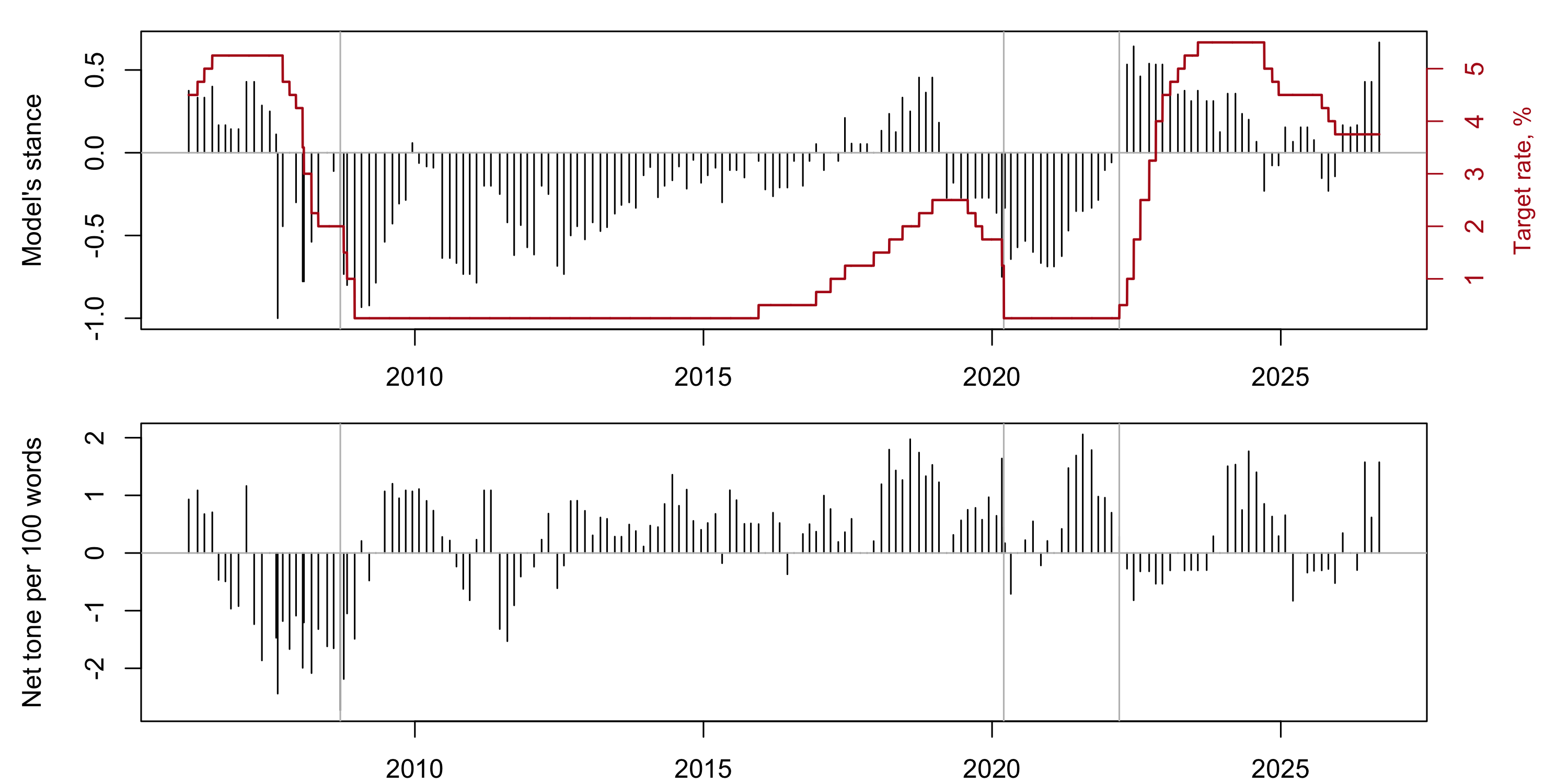
The checked closed model (the 27-billion open model would do as well) labelled the 2,540 sentences of the 171 Fed policy statements, which nobody labelled by hand. Each bar is one statement:

Stance (top) moves with the Fed’s rate (red). Net tone (bottom), the word count, does not: it measures good or bad news, a different thing.

Stance: hawkish minus dovish share of the closed model’s labels on each statement’s sentences. Red: the Fed’s target rate (upper limit, FRED). Net tone: positive minus negative words per 100. Grey: Sep 2008 (Lehman Brothers fails), Mar 2020 (pandemic rate cut), Mar 2022 (first rise after it).

Practice

Eleven exercises on the session page, with solutions behind a click, on the files in the 17-text-llms folder. Tasks 1–9 need no key; task 10 needs ellmer and your own key; task 11 an open model on your own computer.

  • 1–2 The target range for the Fed’s main interest rate: a second regular expression for the years with a single target rate · the statements where the model and FRED (the Fed’s daily record) differ
  • 3–5 The 2,480 hand-labelled Fed sentences: sentences that appear twice with different labels · twenty more labelled by you · sentences the dataset’s authors cut at a comma
  • 6–8 Model against hand labels: the table of mix-ups read by column · sentences about inflation · the rule that counts positive and negative words, against the model
  • 9 Runs and cost: the labels that changed between two runs · the cost of each run
  • 10 With your own API key (needs the ellmer package): a few labelled examples added to the instructions
  • 11 With an open model (one you download and run on your own computer): twenty sentences labelled for free